Thursday, July 8, 2010

Morning on the Swift


With all the heat we've been having these last few weeks, a Saturday morning trip to the ice-cold Swift River in Belchertown, MA was in order. The Swift is a nicely maintained tail-water fishery; big, healthy rainbows and browns are usually easy to find, but not always easy to catch.


A discharge rate of 38fps was a good sign, but my friend and I only managed one fish between the two of us. Although that one fish could certainly be "fish of the year;" my friend had his work cut out bringing in what turned out to be a heavily muscled, hard fighting rainbow of around 16-18 inches on his 3-weight.

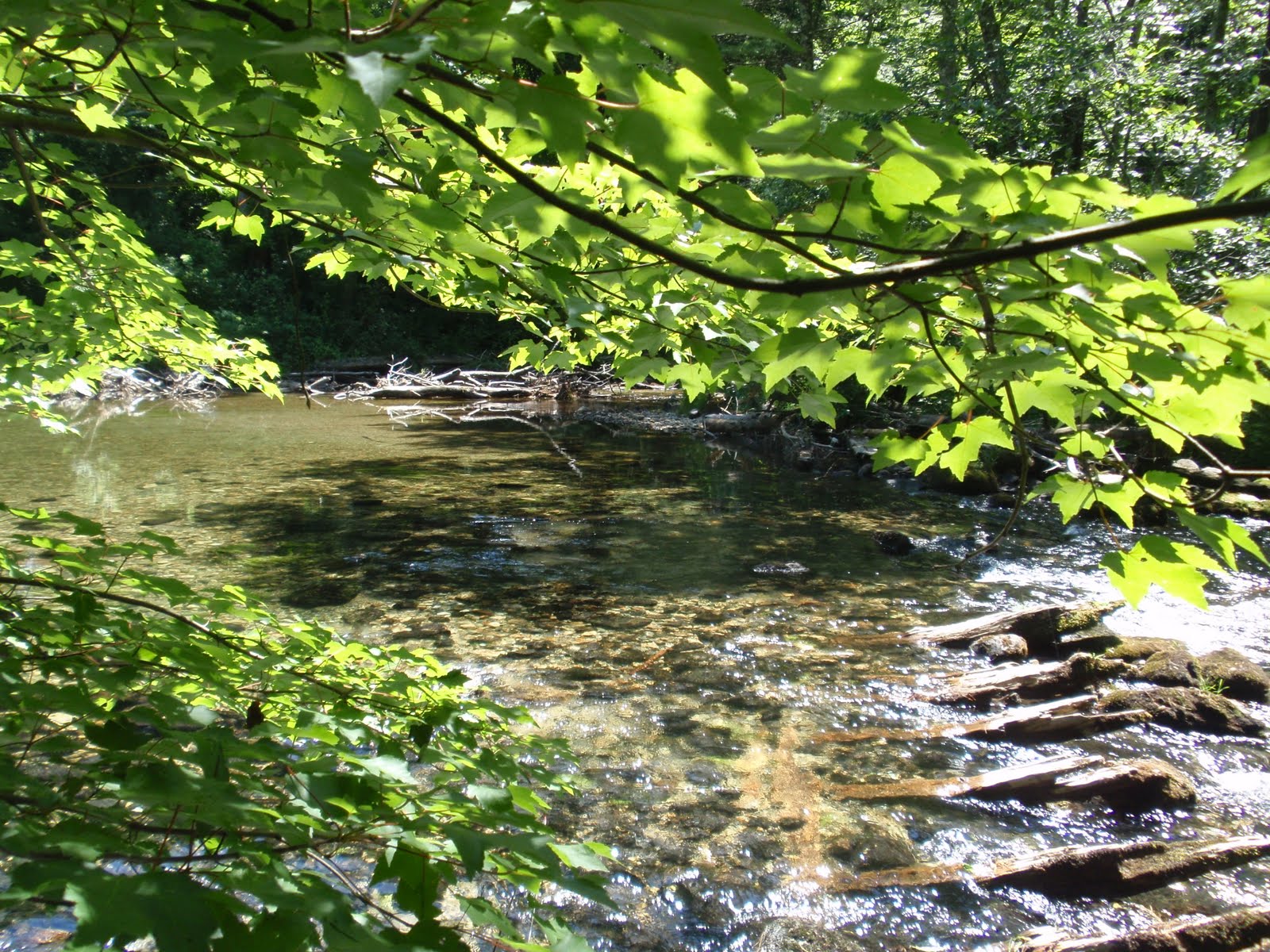
As far as catching more fish, the fly-fishing-only (FFO) section upstream might have been a better bet. Problem was there were at least 10 cars parked at the trailhead, quite a crowd for less than a mile of river! I can imagine the famous Y-Pool was getting fished pretty hard. As it turned out we had this little section of the river to ourselves, which was just fine by me, it's prettier than the FFO section anyway:


The remains of a timber dam built on a stone foundation


Slack water above the old dam


Some company streamside

Tuesday, July 6, 2010

Pheasant Tail Sakasa Kebari


Here's another "just for the heck of it" variation on the sakasa kebari blending some elements of Frank Sawyer's Pheasant Tail Nymph with the Japanese reverse hackle tradition. The idea of using pheasant tail fibers for the body of a sakasa kebari struck me the other day when I found my long unused pheasant tail in my drawer of tying stuff - why not give it a shot? As a fly pattern Frank Sawyer's original PT nymph has seen so many variations already, I can't imagine mine is too much of a corruption! I think I've even seen a western soft-hackle version tied with partridge at the local fly shop, come to think of it.

Thursday, July 1, 2010

TenkaraBum Horsehair Line


Horsehair has a long history as a material for fishing line in the West, and I presume in Japan as well. I think I might have first heard about horsehair tenkara lines when I read Yvon Chouinard's article in Fly Rod & Reel titled "Simple Gifts" in which he describes fishing with a tenkara rod and horsehair line, or maybe it was when I found Michael Hackney's blog, Eclecticguy.com. In any case, there has been a fair bit of quiet hype around horsehair in American tenkara since the sport was introduced to the US on a large scale by TenkaraUSA last spring.

There were a few reasons why I wanted to try a horsehair line, for one thing, I wanted to try it out for myself and see why some folks like it so much. I also saw it as a way to get closer to fly fishing's origins, both in the West and in Japan, since I'm somewhat of a history buff. So when Chris Stewart began offering horsehair lines through TenkaraBum.com, I jumped at the chance. For $25 plus shipping, Chris made me an 11' 2" furled and tapered horsehair line customized for my rod.

Chris has been working with horsehair for quite sometime, I don't know for exactly how long, but at least since he got into tenkara, and likely before then given his interest in western angling history, and British loop-rod fishing in particular. He knows what he's doing; I've tried to replicate his results furling my own snoods (the furled segments which are knotted together to build the line), but Chris' line has a consistent furl that I haven't yet been able to match.

Overall the line is very nicely put together, and the taper is well designed -- the line turns over like a rocket without being too heavy. Besides the tapered design, this is because horsehair is dense. It is denser than nylon mono, and even fluorocarbon. Thus for the same weight of line horsehair has a narrower cross section, and so experiences much less aerodynamic drag. I really noticed this when I switched back to my furled nylon-mono line from TenkaraUSA (this is not a bad line either!). The two lines are of roughly the same weight, but one can really feel the extra drag with the furled mono line, the turnover is slower, and the line loses impetus in the cast much faster and one has to load the rod more heavily. Chris' horsehair line on the other hand only needs a gentle flick to completely unroll all the way to the fly. I found roll-casting in tight spaces to be fantastically easy, and normal tenkara casting to be a real pleasure.

However, there are a couple things you should know before you fish horsehair. Like many materials, horsehair is fantastic within it's limits. If you exceed those limits, it will break. It's not that horsehair isn't tough or durable, it just doesn't have as much tensile strength as modern line materials. This is made problematic by another property of horsehair, namely that individual horsehair strands will stretch at different rates. So, if you try to yank your fly out of the bushes, you could break your line, or break a strand in one of the segments. If you hook a really big fish, you could also break something. I'd recommend using a light tippet (at least 6x) to protect your line. Lucky for us, Chris will repair broken lines for a reasonable price ($5 per broken or missing segment, $1 shipping). I'd recommend taking advantage of this offer. I was fortunate that I live less than an hour from Michael Hackney, who makes furled western fly-lines out of horsehair. So thanks to Michael, when I broke my TenkaraBum line I was able to get it fixed, and learn a furling method just in time for my backpacking trip in the Pemigewasset. Based on my experience furling so far, the reason I'd recommend having Chris repair your line (at least the first time) is that furling horsehair snoods takes practice and a little skill to get really good results, so wait till you know what you're doing!

The whole line coiled up.


Chris' attachment of the loop


The tippet ring is a nice touch. This is the section Michael Hackney and I replaced, Chris' original furl was a bit tighter.


The line is composed of furled snoods neatly knotted together.


Friday, June 25, 2010

Tenkara Flies Analyzed

Yesterday I posted about my experiences with soft-hackled sakasa kebari, and what should I see this morning on TenkaraUSA's blog but a post on Fujioka-san's study of traditional tenkara flies!

Take a look, there's not a whole lot of information, but it will give you a general idea of the different sorts of flies commonly used in Japan:

http://www.tenkarausa.com/blog/

I'm particularly intrigued by the stiff hackled flies. Soft-hackles are just so logical to me for wet flies! As I find with a lot of new knowledge, this little study makes for more questions than answers. 

Thursday, June 24, 2010

Thoughts on Flies


Lately, a lot of discussion has been stirred up revolving around simplicity and minimalism in tenkara. Much of the talk concerns the "one fly" approach that is so characteristic of traditional tenkara practised in Japan. The extent of this practice wasn't fully understood in the US until recently, when Daniel Galhardo (TenkaraUSA founder) had the opportunity to spend two weeks fishing in Japan with a few of the most respected tenkara anglers alive today. Daniel's reports on his experiences are proving to be an invaluable resource for American tenkara anglers who want to know more about what he calls "pure tenkara" - tenkara as it is traditionally practiced in Japan. So in order to explore the "one fly" approach I've only been fishing variations on one fly, the sakasa kebari:


My bread-and-butter sakasa kebari: black thread and pheasant hackle on a curved shank hook


The sakasa kebari from what I gather, is one of the most common types of flies used in Japan. I'd hesitate to call it a "pattern," since there are so many variations, it's more a broad style of wet fly tied with a distinctive forward sloping "reversed" hackle. In it's simplest incarnation all you need for a sakasa kebari is a hook, thread, and soft-hackle, making it a very quick and enjoyable fly to tie (great for beginners). It's also a blast to fish!

My addiction to sakasa kebari started small, I tied a few when I was learning how to tie since they looked easy, and they were interesting. I didn't fish them much until May of this year, and I haven't missed my dries and nymphs yet.

I've found that using one fly pattern changes the experience of fishing. It forces you to focus on presentation, and with tenkara wet flies that means achieving the right "swimming" action. I also find that not having to think too much about fly choice can be a big relief, especially if you're one to worry about it - and once you start catching fish you'll forget about all that, believe me. After having spent about a month fishing only sakasa kebari flies, I have to say that "one fly" hasn't affected the amount of fish I catch, if anything I've actually caught more fish. I haven't found it limiting in the least.

Hopefully with this post I can illuminate the "one fly" approach by offering my current interpretation of it. To me, "one fly" means fishing one fly pattern, or one style of fly. That doesn't mean I'm limiting myself in terms of sizes, colors, or hackle materials (only to keep the fly tying interesting!), but each fly will be tied by the same method.  With the sakasa kebari the general idea is to build a fly with a forward sweeping hackle that will have a lot of action in the water when pulsed or twitched past a likely spot.

This weekend I fished four different sakasa kebari in two streams for wild brook and brown trout. I started off fishing a new stream on saturday with a size 12 fly tied with red thread and pheasant hackle:


I drew a few strikes from a good sized brookie, but failed to hook up before landing a small trout in the next pool. After fishing a little while I came to this deep pool below a dam:


Here I decided to switch flies and try something else I'd tied in the past week just for kicks:


Again, this fly uses pheasant hackle, this time with black thread and copper wire for the body. I wanted something with a little flash for stained or cloudy water, just to make the fly a little bit more visible. It did the trick here, I proceeded to hook and land maybe 8-10 little brookies from that pool! But really, who's to say the first fly wouldn't have worked either?

I had a little time on Monday afternoon to fish, so I headed to another of my favourite streams. Here I decided to use my starling hackled sakasa kebari:


I caught three brookies in a few different pools using this fly before I found a good sized brown that just wouldn't get hooked after several lackadasical strikes. Maybe something a little meatier would help:


Fresh from fishing: "takayama sakasa kebari," size 12, black thread, pheasant hackle, peaccock herl and thread body

The second cast drew a violent strike, and I landed this guy after a hard fight on the Iwana:


To close out this post, here are a few more simple sakasa kebari variations:


When it comes to these flies, one has a lot of freedom as a fly tier. Try out different body materials, threads, dubbings, peacock herl, etc. Experiment with different hackles, personally I like soft hackles for their liveliness in the water. Pheasant, starling, partridge, snipe, and so forth should all work well. Just don't forget that it doesn't take anything fancy to catch fish with these flies.